
From July 26 to 27, the 2025 Annual Conference on Development Geography, jointly organized by the Committee on Development Geography of the Geographical Society of China and Anhui University of Finance and Economics (AUFE), and hosted by the Anhui Provincial Key Laboratory of Philosophy and Social Sciences for Low-Carbon Development and Carbon Finance at AUFE, was held in Hefei.
Under the theme “Development Geography and the Building of a Beautiful China,” the conference aligned closely with China’s goals for ecological civilization development and its “dual carbon” strategy. It attracted more than 100 experts and scholars from over 50 universities and research institutions, including the Chinese Academy of Sciences, Peking University, Tsinghua University, and Nanjing University.
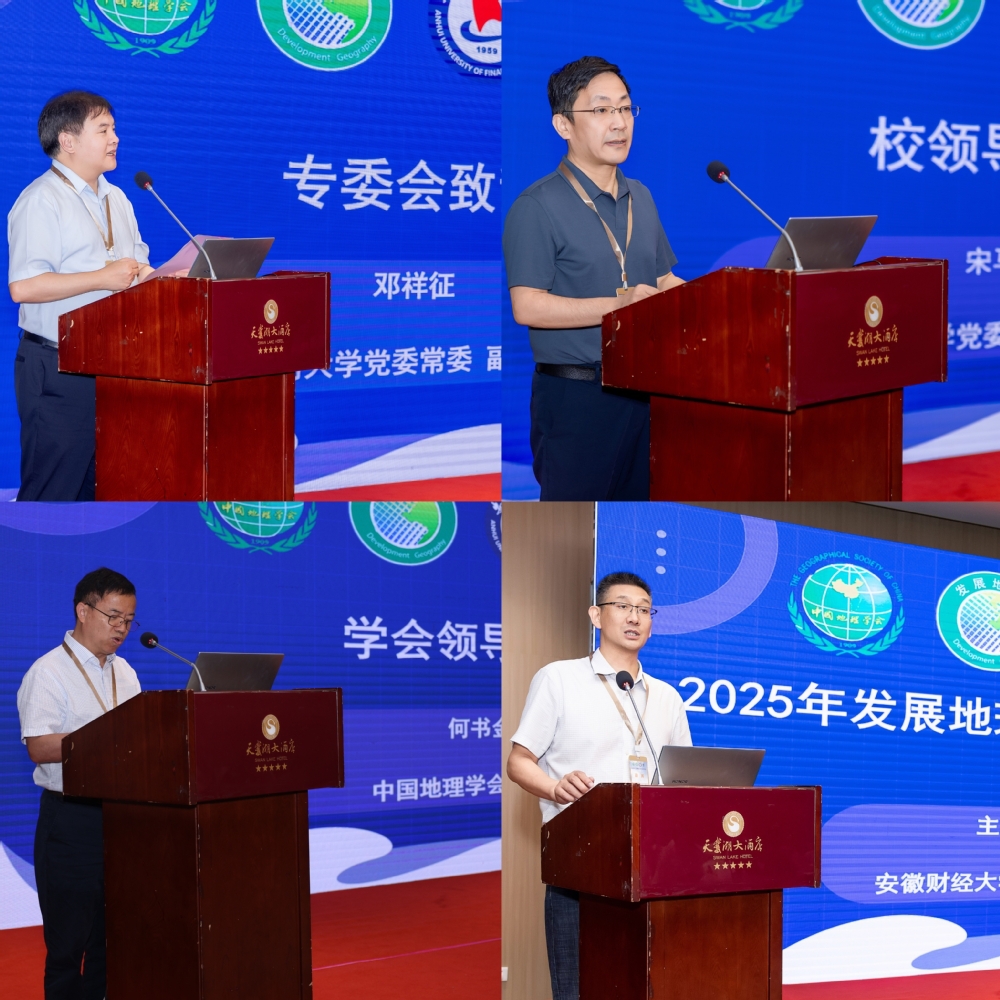
On the morning of July 26, the opening ceremony was chaired by Professor Wan Guangcai of AUFE. Professor Song Malin, Member of the Standing Committee of the CPC AUFE Committee and Vice President of AUFE; Research Professor He Shujin, Deputy Secretary-General of the Geographical Society of China; and Professor Deng Xiangzheng, Chair of the Committee on Development Geography, attended the opening ceremony and delivered remarks.
During the keynote session, six experts and scholars—Professor Tang Baojun of Beijing Institute of Technology, Professor Sun Jiuxia of Sun Yat-sen University, Professor Li Miao of Tsinghua University, Professor Huang Xianjin of Nanjing University, Vice President Shu Wenqi of the China Institute of Urban Development, and Research Professor He Shujin of the Chinese Academy of Sciences—delivered keynote presentations on cutting-edge topics including multi-energy coordination in the low-carbon transition, culture- and tourism-driven rural revitalization, cross-media environmental simulation, the mechanisms of carbon effects in territorial space, the restructuring of governance platforms driven by data as a factor of production, and the development of journal-cluster platforms.

The conference also featured three thematic parallel sessions focusing on development economics, natural resources and territorial governance, and responses to extreme climate risks. Discussions covered eight major areas: ecological value assessment and pathways for ecological product value realization; ecological security barriers and biodiversity conservation; integrated “Five Waters” governance and regional green development; territorial spatial planning and ecological restoration; green, low-carbon and circular economic development; responses to extreme climate and disaster risks; artificial intelligence, big data and ecological and environmental governance; and coordinated development of the ecological environment and the economy and society.
Through extensive academic exchanges across these areas, the conference provided new impetus and support for China in responding to global development trends and participating in global environmental governance.
